

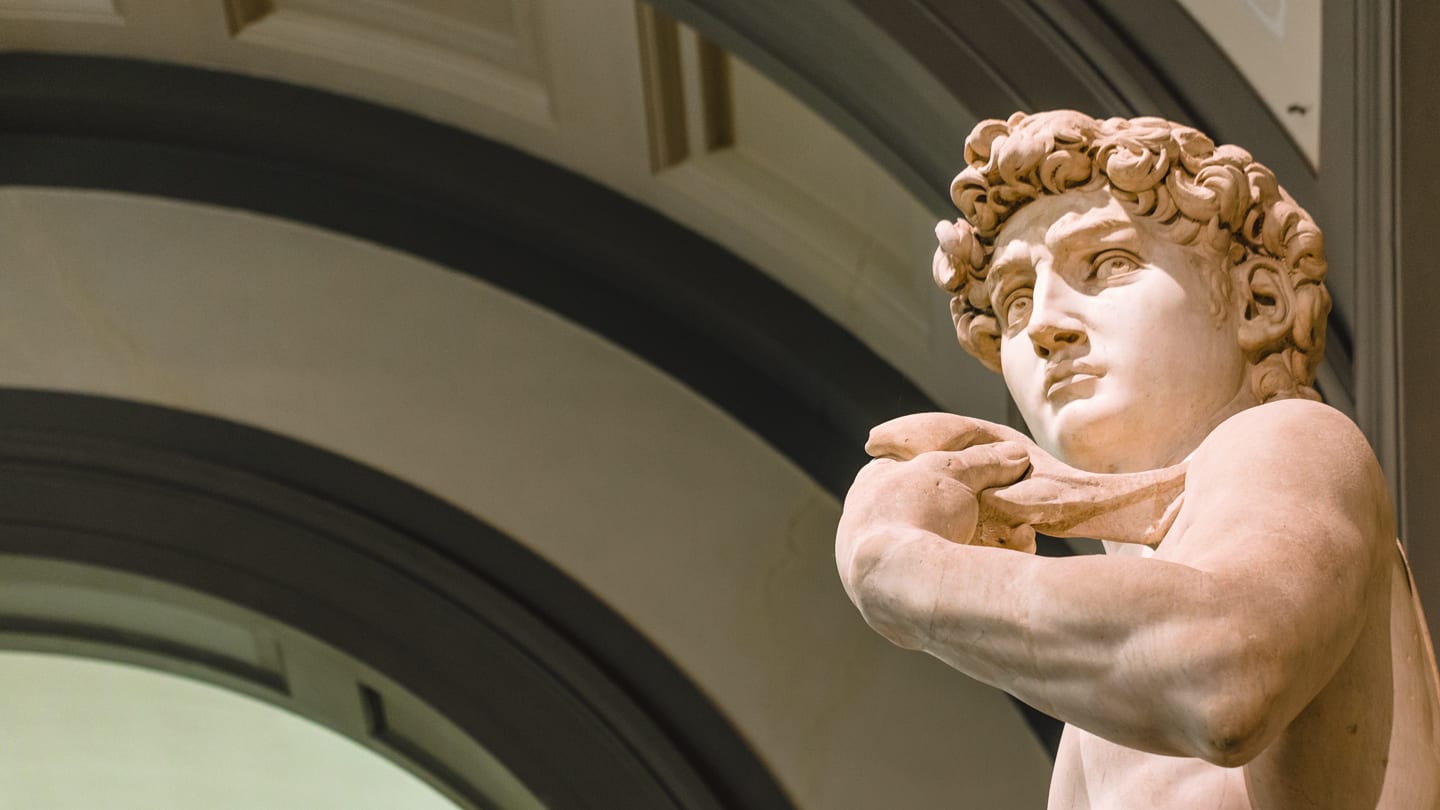
Stand in front of Michelangelo's David for long enough and something unsettling happens.
You begin to feel that the marble is breathing.
The tension in the shoulders. The slight tilt of the head. The tendons visible in the hand that hangs at his side, coiled with restrained energy. None of this should be possible in stone. And yet it is there — undeniably, inexplicably present.
This is not an accident. It is the result of a set of discoveries, accumulated over centuries, about how the human eye reads the human body — and how to exploit that reading through sculpture.

The Architecture of Flesh: Anatomical Mastery
Greek sculptors studied the living body with the same intensity that engineers study structures.
They observed how the deltoid muscle creates the rounded form of the shoulder. How the sternocleidomastoid cord in the neck becomes visible when the head turns. How the weight of a raised arm changes the relationship between the ribcage and the pelvis. They were not decorating a surface — they were reconstructing a system.
During the Renaissance, this study became even more literal. Michelangelo and Leonardo da Vinci both dissected human cadavers — an activity that was dangerous, illegal in certain circumstances, and deeply unsettling by the standards of their time. They did it because they understood that to sculpt the body convincingly, you had to understand what lay beneath the skin.
The result is visible in details that should not be possible in marble: the slight protrusion of a collar bone. The depression above the knee where the quadriceps inserts. The way the abdominal muscles separate into distinct forms when the torso twists.
These are not decorative choices. They are anatomical facts, rendered in stone.

The Body in Motion: Contrapposto
Before the Greeks, sculpture was rigid.
Egyptian figures stood with both feet flat, both shoulders square, facing directly forward — images of eternal stillness rather than living presence. Powerful, yes. But unmistakably stone.
Greek sculptors of the Classical period made a revolutionary observation: the human body at rest is never symmetrical. When we stand, we shift our weight to one leg. The hip on that side rises slightly. The opposite shoulder drops to compensate. The spine curves in a subtle S. The whole body enters a state of dynamic balance — not stillness, but equilibrium.
They called this contrapposto — counterpose. And once they understood it, they could not unsee it.
The result was figures that appear caught mid-moment: not frozen, but paused. The Doryphoros of Polykleitos, carved around 440 BCE, is perhaps the earliest complete expression of this principle — a figure so naturally balanced that it convinced the eye it might at any moment shift its weight and walk away.
Michelangelo inherited contrapposto and carried it to its extreme. His David does not simply stand. He waits — his body in perfect tension between the stillness before decision and the violence that will follow it.
The Material Itself: Why Marble Works
Not all stone is equal.
Marble has a property that sculptors understood intuitively long before scientists could explain it: translucency. Light does not simply bounce off the surface of marble — it penetrates slightly, scatters within the crystal structure, and re-emerges. The effect is a soft, diffused glow that closely resembles the way light behaves beneath human skin.
This is why marble figures appear to have warmth. Not because the stone is warm — it is not — but because the light behaves similarly to living tissue. The eye recognises the pattern and fills in what it expects to find.
The great sculptors understood this intuitively. They polished their surfaces to precisely the degree that maximised this translucent quality — not so smooth that the surface became mirror-like, not so rough that the light scattered too broadly.
They were, in effect, sculpting with light as much as with stone.

Emotion Carved in Stone
Anatomical accuracy alone does not explain why these figures move us.
A technically perfect sculpture can still feel cold. What separates the great works — the David, the Laocoön, the Dying Gaul — is that they convey psychological states through purely physical means.

The furrowed brow. The slightly parted lips. The tension in a jaw set against pain. These are expressions that the human nervous system reads automatically, below the level of conscious thought. We do not decide to feel something when we look at the Laocoön writhing in the grip of the serpents. We feel it before we understand why.

This is the deepest secret of classical sculpture: the body is not merely depicted. It is used as a language — one that bypasses rational analysis and speaks directly to the part of us that recognises suffering, strength, beauty, and resolve in other human forms.
Why This Still Matters
The figures that Greek and Roman sculptors carved two thousand years ago — Athena, Apollo, Aphrodite, Ares, Hermes, Hercules — were not simply religious objects or decorative forms. They were attempts to give permanent shape to ideas: wisdom, beauty, power, speed, strength. To make abstract qualities visible, tangible, present in a room.

That ambition did not die with antiquity. It passed through the Renaissance, through Neoclassicism, and continues — in different materials and methods — into the present.
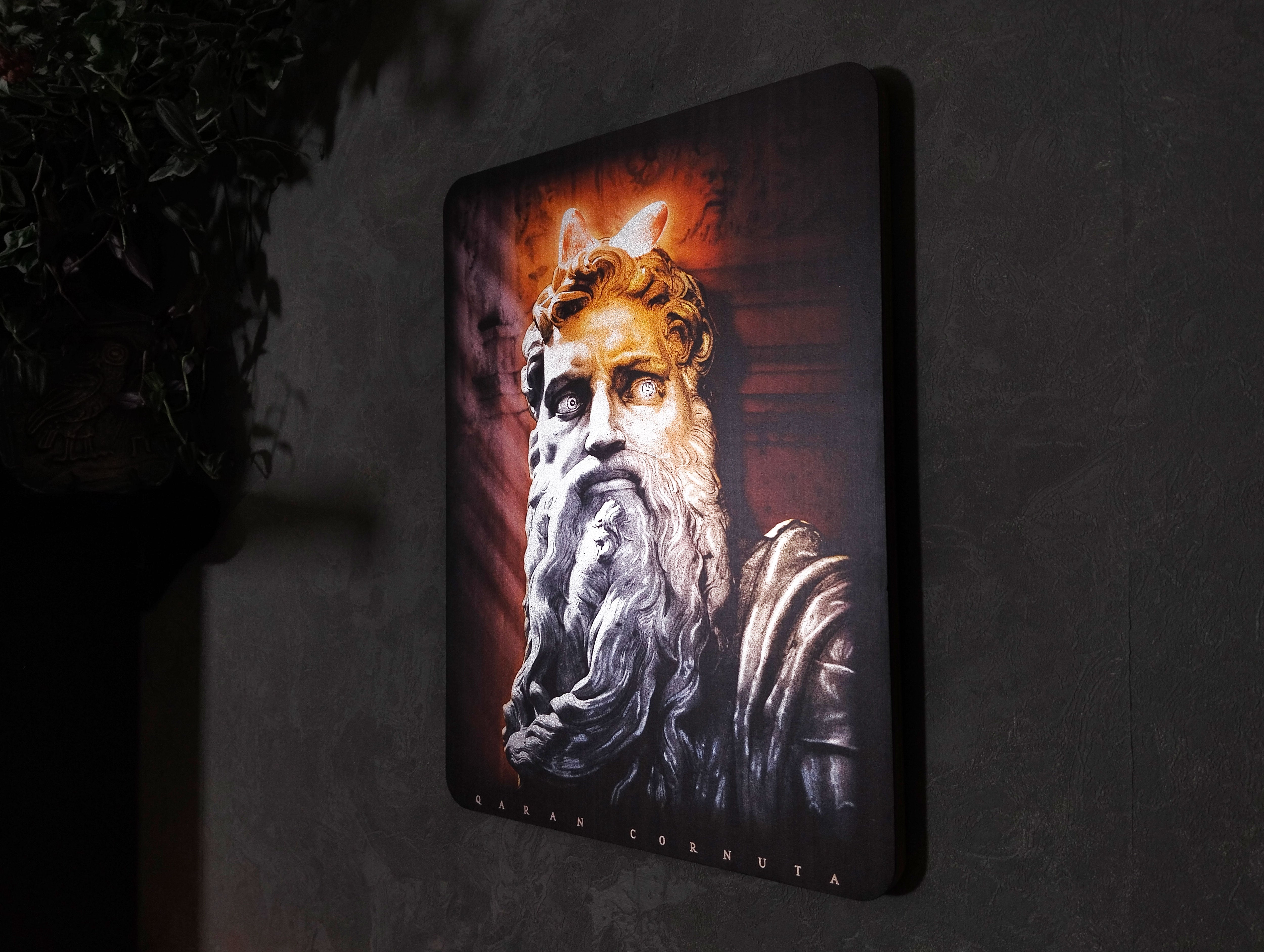
At Wallupin, we work within this tradition. Our Silver-Lit Re-Forms collection takes the same figural heritage — the same gods and heroes that Greek sculptors first rendered in marble — and reinterprets them through a contemporary lens. Hand-applied metallic leaf on 18mm birch plywood creates a surface that responds to light as the ancient sculptors intended their marble to respond: differently depending on where you stand, shifting as the light in the room shifts, never quite the same twice.
These are not reproductions. They are continuations.
Share:
1 comment
This explains a lot. It’s fascinating how realism in classical sculpture isn’t just technical skill, but a deep understanding of anatomy, light, and ideal proportions.