

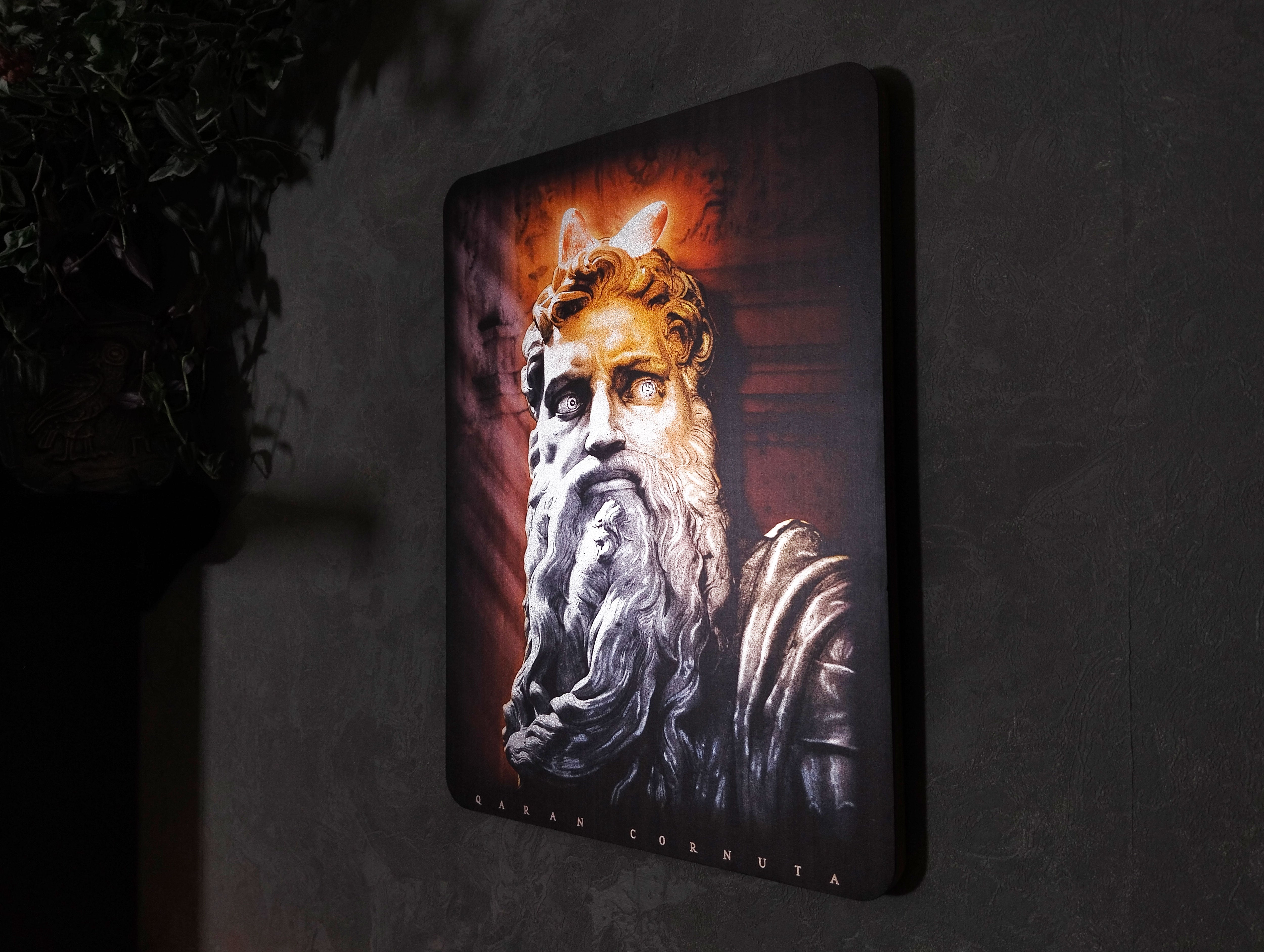
Qaran Cornuta: Not a Demonization, but a Translation Error
A centuries-old translation mystery that shaped one of the most famous sculptures in art history.
Sometimes the fate of a figure is not decided by the hands of a sculptor, but by the choice of a single word.
Qaran Cornuta stands precisely at that point.
It is not a demonic figure, nor an attempt at provocation. On the contrary, it points to one of the most enduring semantic accidents in history.
This is not demonization.
This is a translation error.
Jerome’s Translation Error
In the 4th century AD, Saint Jerome was translating the Old Testament from Hebrew into Latin — a monumental undertaking that would become the Vulgate, the definitive biblical text of the Western world for over a thousand years.
While working through the Book of Exodus, he encountered the Hebrew word qaran.
The word does not mean "horned."
It means radiant. Emitting light.
The passage describes Moses descending from Mount Sinai after speaking with God — his face shining with something beyond ordinary illumination. A man transfigured by proximity to the divine.
Jerome translated qaran as cornuta — horned.
A single word. A single decision. And from that decision, an entire visual tradition was born.
What had been a description of radiance became a physical attribute. What had been light became horn. What had been divine proximity became, over centuries of misreading, something closer to menace.
This is not demonization. This is what happens when language carries more weight than anyone intends.
With this single mistranslation:
- Wisdom slowly turned into fear,
- Light became threat,
- And the sacred drifted toward the demonic.
And this transformation was quietly accepted for centuries.
Michelangelo and the Horned Moses

Michelangelo’s famous Moses stands as the most recognizable result of this translation error.
The horns in the sculpture are not symbols of rebellion or darkness. They were conceived as physical manifestations of divine knowledge.
But as time passed, the viewer changed.
Meaning slipped.
What once suggested illumination began to evoke unease.
Qaran Cornuta exists precisely within this shift.

Why the Horns?
In this work, the horns are not symbols of:
- Sin,
- Darkness,
- Or evil.
They represent misunderstood knowledge.
They stand as a reminder of how a single linguistic error can evolve into a collective fear over time

Why the Horns Still Matter
The horns on Michelangelo's Moses are not symbols of sin, darkness, or rebellion.
They are a monument to misunderstood knowledge.
They remind us how a single linguistic error — made in good faith, by one of the most careful scholars of his age — can calcify into collective assumption across fifteen centuries.
To stand before the Moses in Rome is to stand before a question that the stone itself cannot answer: what else might we be reading wrong?
The light in this work is deliberately restrained. It does not dramatize. It does not explain. It simply exists — quietly — not to illuminate the figure, but to pause the viewer long enough to ask.
Light: Not to Reveal, but to Remind
The light in Qaran Cornuta is deliberately restrained.
It does not dramatize.
It does not explain.
It simply exists — quietly.
Not to illuminate the figure, but to pause the viewer.

Michelangelo’s Moses Sculpture

To invite a single question:
“What else might we be wrong about?”
The Biblical Passage Behind the Horns

The Wallupin Perspective
Our Moses wall artwork was conceived as an extension of this question.
It is not a decorative reproduction of Michelangelo's sculpture. It is a reinterpretation — produced using the Silver-Lit technique, where hand-applied metallic leaf creates a surface that responds to light the way the original stone responds to the eye: differently, depending on where you stand and how the light falls.
The horns remain. Not as symbols of darkness, but as a reminder that what we inherit from history is not always what history intended.
Each piece is a limited studio edition — individually produced, not mass manufactured.


Final Note
Qaran Cornuta is not dark.
What we often call darkness is, at times, nothing more than a light that was translated incorrectly.

Share:
1 comment
I always thought it was meant to look intimidating, but this completely changed my perspective. The idea that it comes from a translation nuance makes it even more fascinating. Now I’m curious how many other artworks we’ve misunderstood because of translation.